
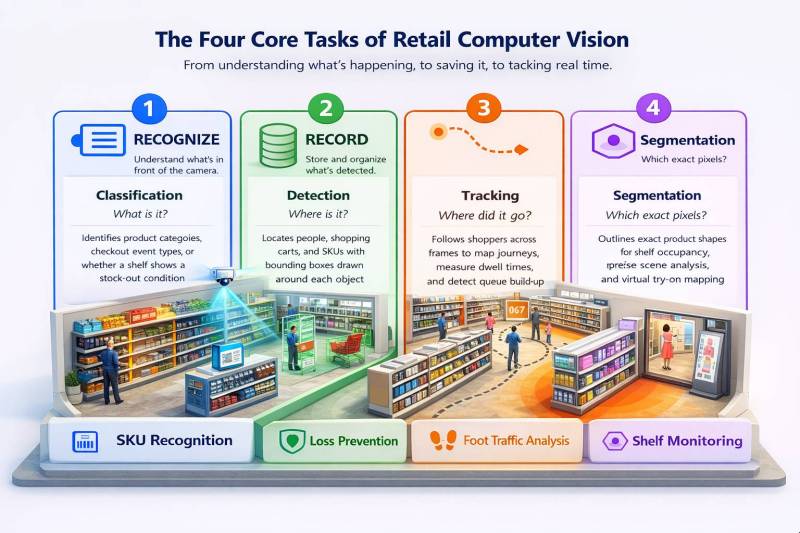
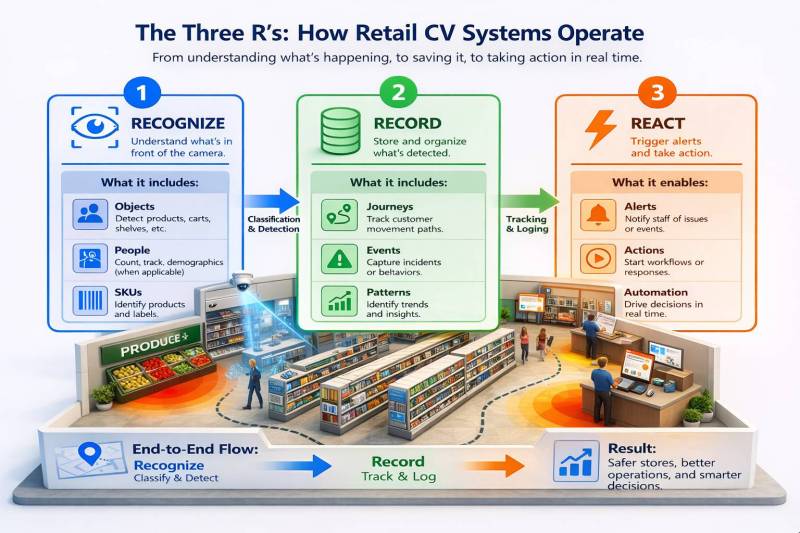
The most mature use cases usually fall into four groups: operations, customer experience, marketing, and risk. The strongest programs rarely stop at a single use case because the same cameras, data flows, and governance model can often support multiple applications.
That is why the better question is not “Should we do computer vision?” It is “Which use cases fit our strategy, pain points, and data readiness right now?”
Foot traffic analysis shows how shoppers move through a store, where they stop, and where congestion builds. Heat maps turn that movement into something merchandising, staffing, and operations teams can actually use.
The value is practical. Teams can test display placement, adjust staffing to real demand, monitor bottlenecks, and compare how the same format performs across locations, times of day, or seasons.
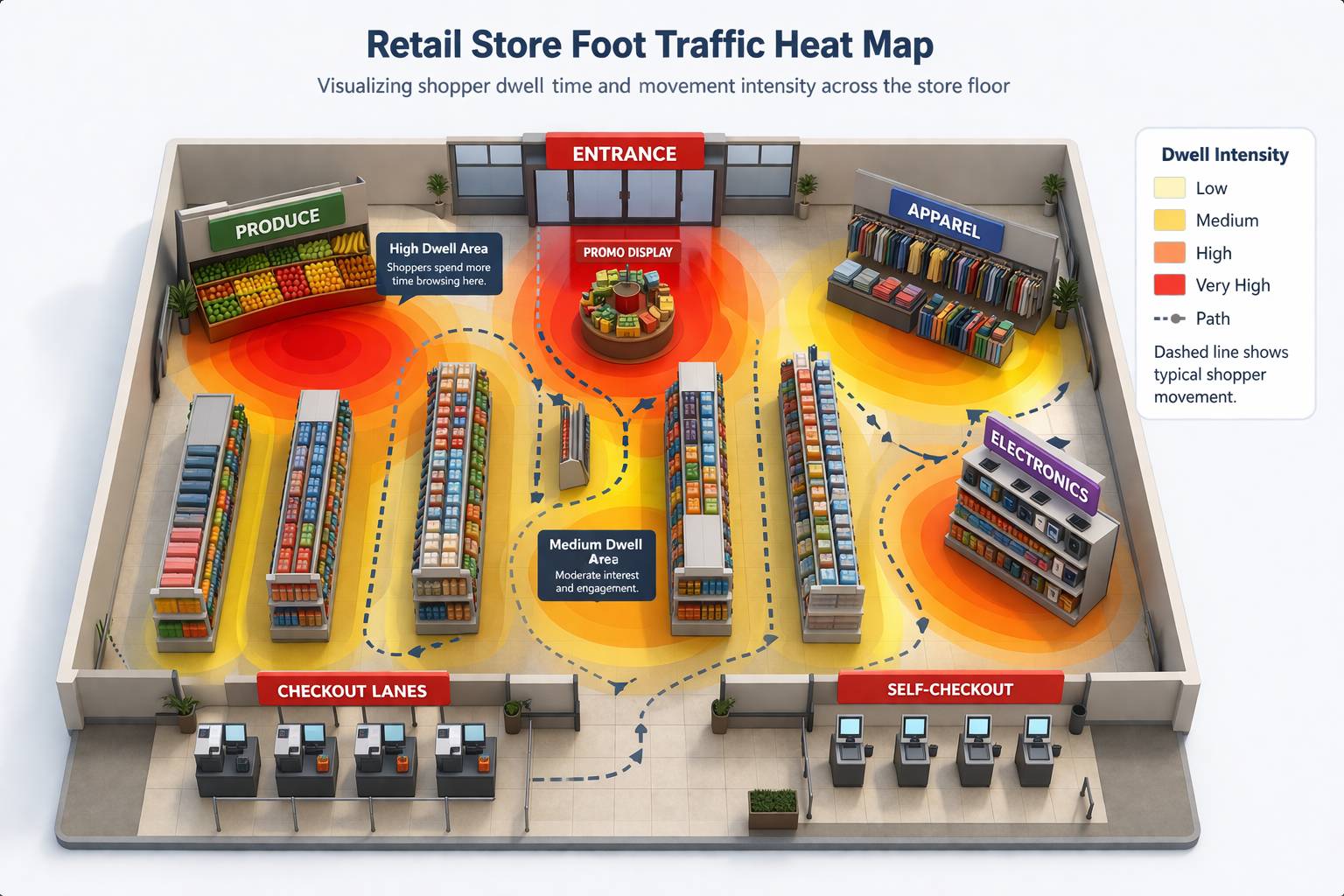
The point of a figure like this is to make the business case tangible. Movement data becomes something store teams can act on, not just something analysts talk about.
Shelf monitoring is one of the clearest examples of retail computer vision creating value. Cameras can spot empty facings, misplaced items, and planogram problems far more often than manual store walks can.
That matters because shelf execution directly affects sales. A product sitting in the back room is still unavailable to the customer if the shelf is empty. When computer vision is tied into inventory and replenishment workflows, stores can react faster and more consistently.
This is also a strong fit for W&B because teams often need to improve product recognition across different assortments, lighting conditions, store formats, and regions. Faster iteration matters here.
Loss prevention gets so much attention because the business case is easy to understand. Computer vision can help flag patterns such as unpaid merchandise leaving the store, suspicious point-of-sale behavior, or unusual movement in restricted areas.
But this is also where governance matters most. The goal should not be blanket surveillance. The goal should be better triage, so teams focus attention where risk is highest while keeping interventions proportionate and defensible.
That is why model traceability matters. Teams need to know which model was deployed, which data trained it, how it performed, and whether it behaves consistently across locations. W&B helps with that audit trail.
Cashierless stores are one of the most ambitious computer vision ideas in retail. They depend on dense camera coverage, strong tracking, event attribution, and reliable payment logic.
For most retailers, the better near-term opportunity is simpler: smarter self-checkout, queue monitoring, dynamic lane opening, better item recognition, and less front-end friction. Those use cases fit more store formats and still improve wait time, labor use, and abandonment.
Where fully cashierless concepts do make sense, experimentation discipline becomes critical. Detection, tracking, and event attribution have to be tuned until the system is reliable enough for the real world.
Computer vision can also help retailers understand how shoppers respond to displays, which zones attract attention, and which experiences drive interest without leading to a purchase.
That can improve promotions, display design, and coordination between in-store and digital marketing. The strongest programs usually emphasize aggregate, anonymized insights rather than identity-heavy tracking.
In other words, computer vision can support personalization, but the best programs use it with restraint so value does not come at the cost of trust.
Virtual try-on is one of the most visible uses of computer vision because shoppers experience it directly. Apparel, beauty, and eyewear brands use it in apps, websites, kiosks, and mirrors.
The value is not just novelty. Better visualization can increase confidence, improve conversion, and reduce returns. It can also create smoother movement between mobile, store, and web experiences.
Most retail computer vision programs create value in four ways:
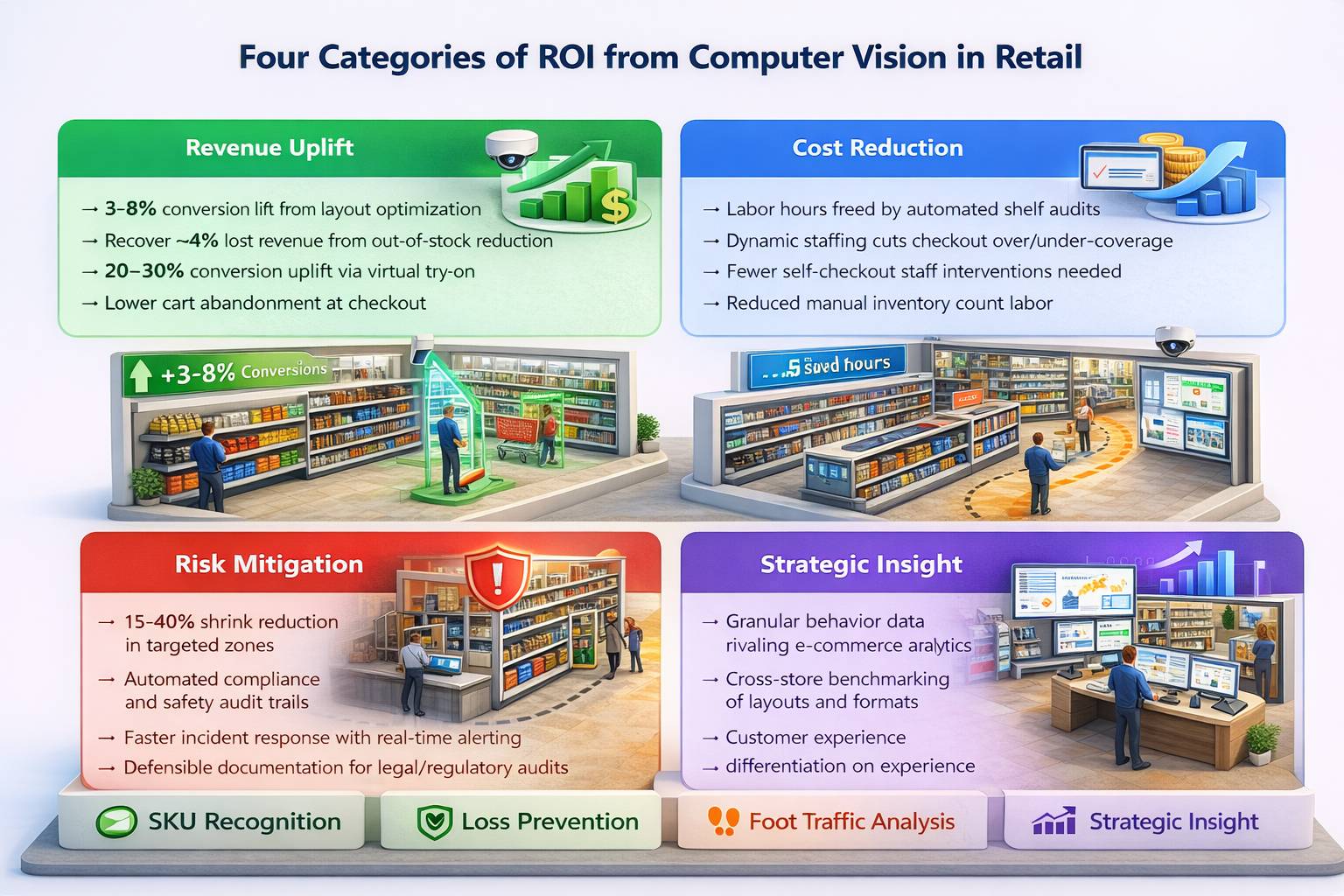
Leaders should measure success with a small number of business KPIs tied to the use case.
| Use Case Category | Primary KPI | Strategic Impact |
|---|---|---|
| Inventory | % Increase in On-Shelf Availability | Direct revenue uplift from reduced stock-outs. |
| Loss Prevention | % Reduction in Shrink/Theft | Margin protection and targeted security deployment. |
| Store Operations | % Reduction in Queue Wait Times | Improved Customer Satisfaction (NPS) and reduced abandonment. |
| Merchandising | Conversion Rate per Square Foot | Optimized store layout and high-value display ROI. |
The strongest ROI story connects directly to an existing scorecard: fewer stock-outs, shorter queues, lower shrink, better labor utilization, or more consistent execution across stores. Time-to-value matters too. A good use case can still stall if experimentation and deployment are messy.
A retail computer vision stack usually includes cameras, edge devices, connectivity, cloud infrastructure, and software for training, deployment, tracking, and monitoring. The main executive point is simple: success depends on the full system, not only on the model.
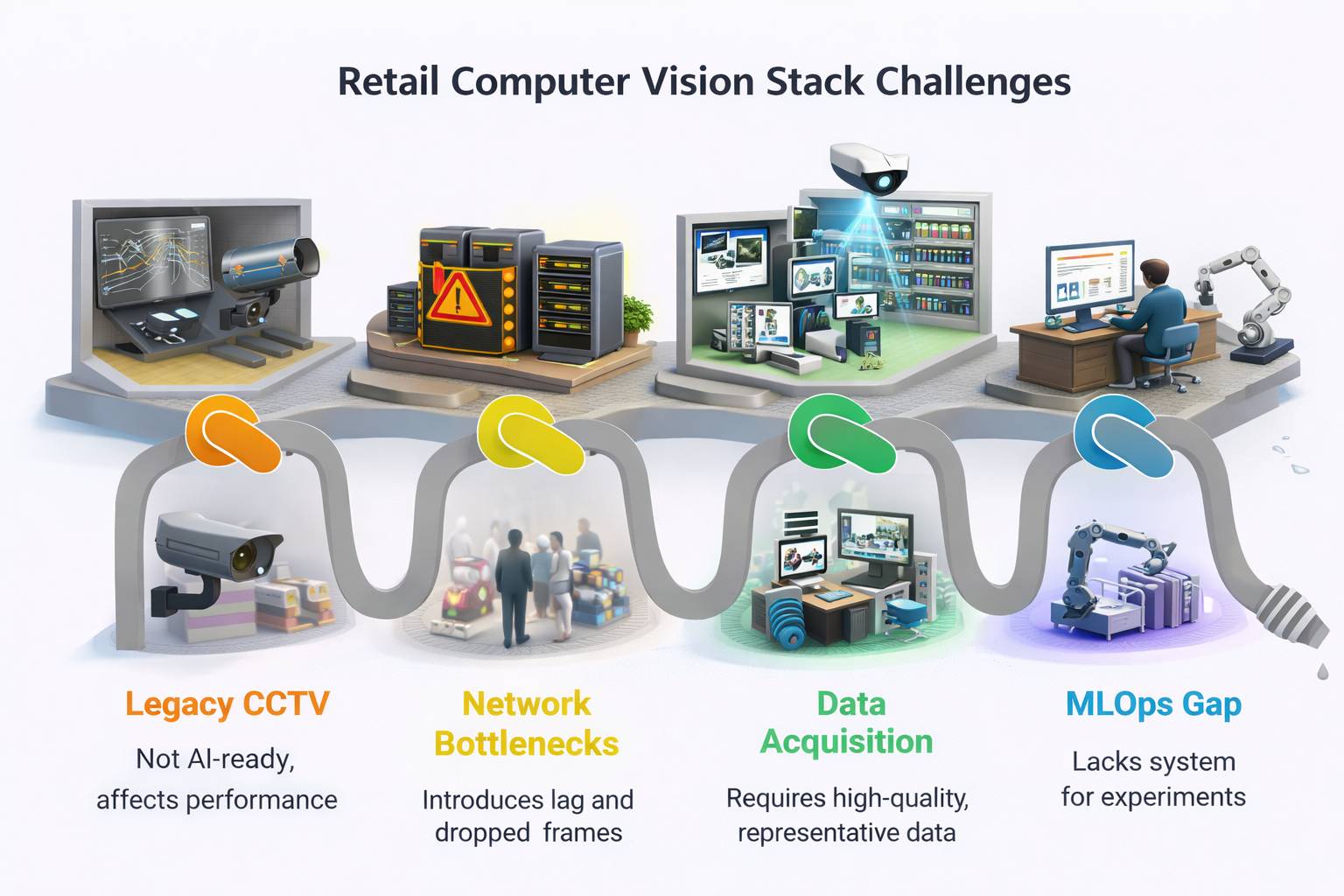
This is why infrastructure questions matter so much. The camera is only part of the story. Older NVRs, switches, routers, and weak store connectivity can make a real-time system feel unreliable even when the model itself is solid.
Many retailers can reuse parts of their existing CCTV network, but not every video environment is ready for AI. Camera placement, resolution, frame quality, lighting, and bandwidth all affect performance. In practice, many rollouts stall because the camera and network path were built for passive recording, not real-time inference.
As the number of stores, models, and datasets grows, teams also need a system of record for experiments, lineage, reporting, and deployment handoffs. That is where MLOps becomes business-relevant, and where W&B helps.
Computer vision in retail raises governance questions early. Laws such as GDPR, CCPA, and biometric privacy rules can shape what is allowed, what must be disclosed, how consent works, and how long data can be kept.
A simple way to manage that complexity is to sort use cases by risk level.
The key distinction is between anonymized analytics and identifiable surveillance. Many retailers can get real value from aggregate insight without building identity-heavy systems.
Internal governance matters too. High-impact use cases need clear ownership, review paths, escalation rules, and audit trails. W&B supports that discipline through experiment tracking, artifact lineage, model versioning, and shared reporting.
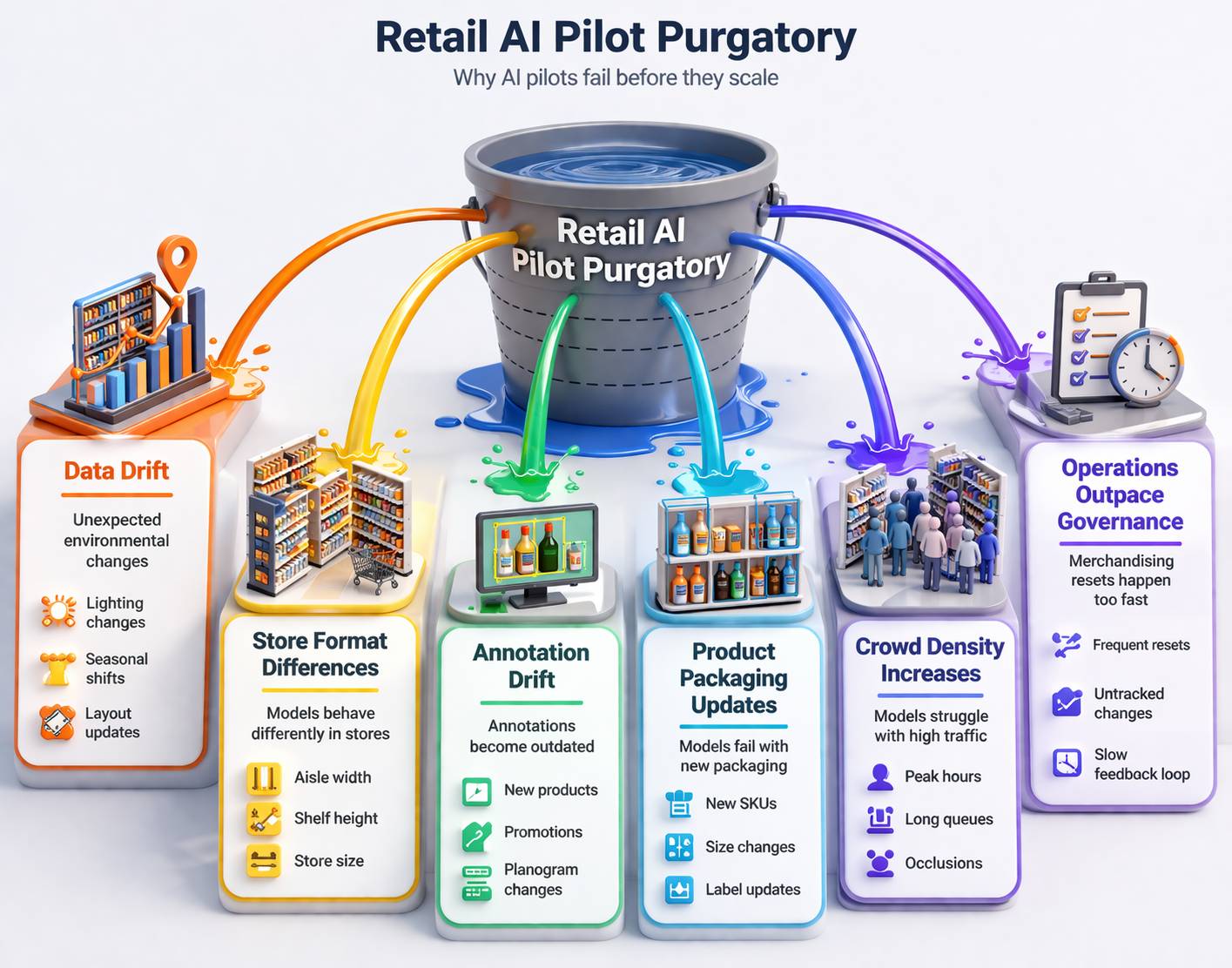
Many retail AI projects do not fail in the first pilot. They fail when teams try to move from one store to hundreds. A model that looked good in a controlled demo can break down across different lighting, camera angles, store formats, and local assortments.
W&B helps teams escape that trap by providing a single place to track models, datasets, metrics, and changes across the network.
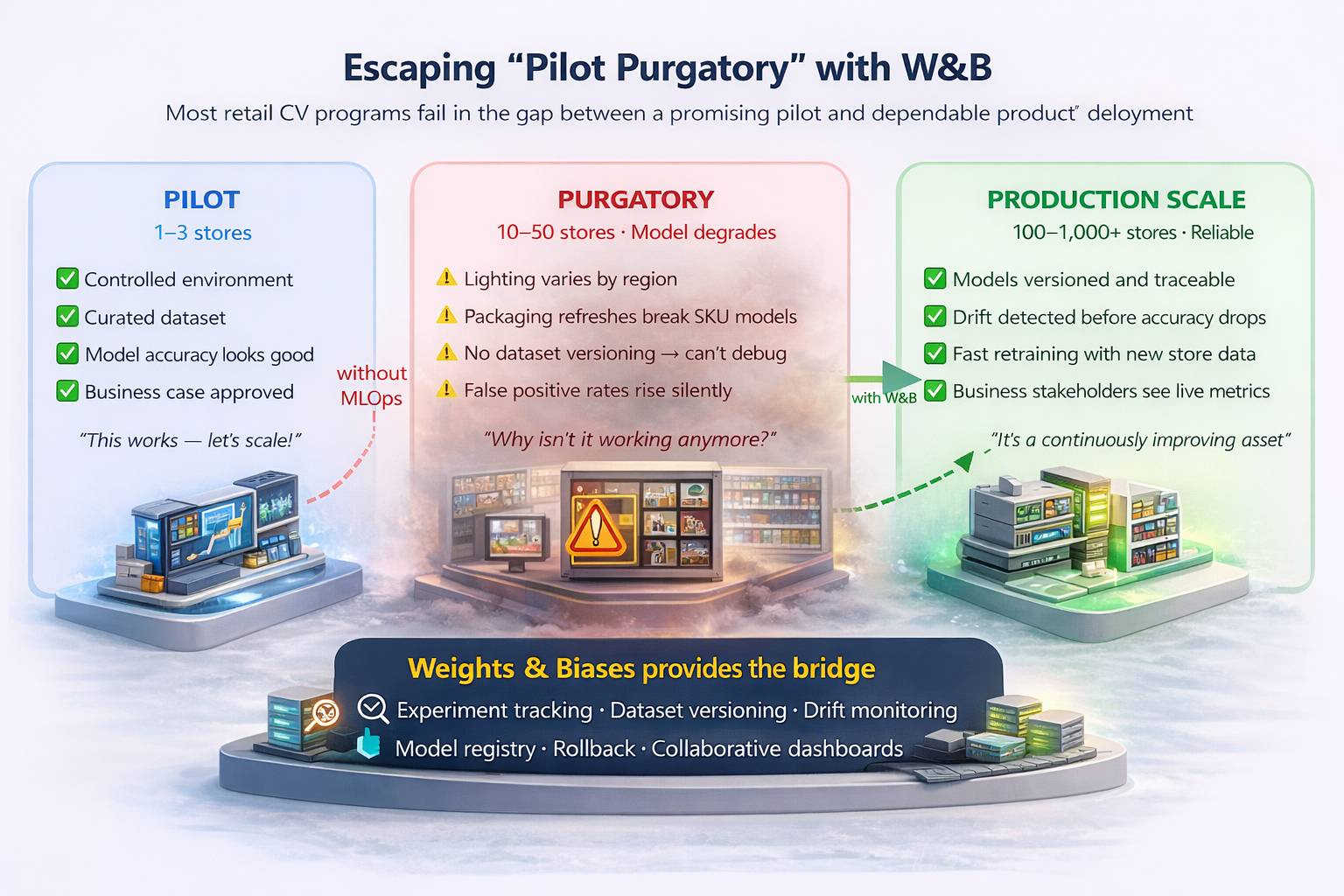
This is the real scaling problem in retail AI. The pilot is often not the hard part. The hard part is making it work across different regions, formats, and operating conditions.
When that information is visible, executives and operating teams can see where value is showing up, where models are degrading, and where intervention is needed.
The platform helps in four practical ways:
That matters because retail models rarely fail for abstract reasons. They fail because packaging changes, lighting shifts, crowd density rises, labeling drifts, or store conditions differ from the pilot. W&B shortens the loop between those problems and the next better model version.
Retail teams often need to compare detection and tracking approaches across many real-world conditions. W&B makes those comparisons more systematic by logging runs, metrics, hyperparameters, and outputs in one place.
That speed directly affects time-to-value. When teams can see what changed and which run improved performance, they reach production-quality models faster.
In retail computer vision, the dataset is often both the moat and the risk. Seasonal assortments, regional packaging differences, changing layouts, and inconsistent labeling can all hurt performance. W&B Artifacts helps teams version datasets and outputs so they know exactly what was used for each model.
That improves reproducibility, but it also matters for governance. Sensitive use cases need stronger documentation, clearer lineage, and safer update processes than a quick prototype.
Many retail computer vision projects fail because production conditions change. A model that works in ten stores may degrade in fifty. Camera angles shift, packaging refreshes, traffic patterns change, and false positives rise.
Retail leaders should treat computer vision as a continuous improvement loop, not a one-time deployment. Teams need to review live performance, capture errors, retrain when needed, and roll back safely if quality slips. W&B helps keep that loop connected.
Executives should treat computer vision as a business program with technical dependencies, not as a standalone AI experiment.
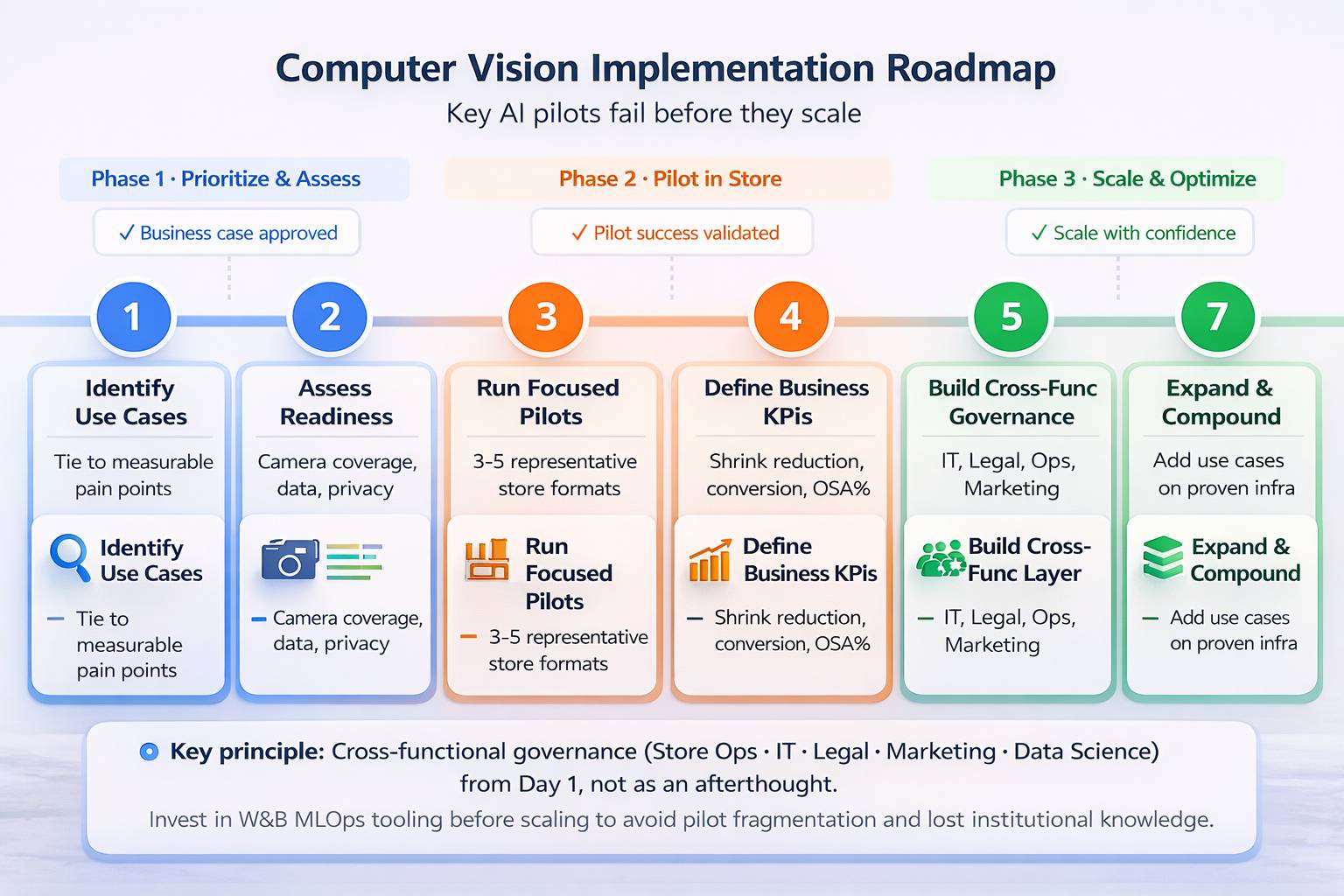
That representative-store point matters. A strong pilot should include the messy locations leaders already know well: older networks, inconsistent lighting, different camera vendors, heavy peak traffic, and layouts that have evolved over time.