
For more information or if you need help retrieving your data, please contact Weights & Biases Customer Support at support@wandb.com
Chatbots have become integral to modern digital banking, serving as the front line of customer interaction across mobile apps, websites, and messaging platforms. Financial institutions deploy these conversational interfaces to handle everything from basic account inquiries to complex transaction disputes, transforming how millions of customers access banking services daily.
For example, a customer can check an account balance, block a lost card, and initiate a dispute through the same chatbot without visiting a branch or calling customer support, transforming how millions of customers access banking services daily.
According to industry analysis, AI-powered chatbots can now resolve approximately 70% of routine customer inquiries in retail banking without human intervention, underscoring the growing role of AI in day-to-day operations.
The core benefits are compelling. Banks gain operational efficiency through automated responses that scale infinitely without proportional increases in cost. Customers get instant answers at any hour, eliminating wait times and phone queues. This combination of better customer experience, faster service, lower costs, and always-on support explains why chatbot adoption has accelerated across the financial sector.
This article examines what banking chatbots are (and aren’t), how they work, their concrete benefits, the risks regulators have identified, and where the technology is headed. We’ll explore different chatbot architectures, real-world applications, compliance considerations, including CFPB concerns, and the future of finance chatbots as AI capabilities continue to advance.
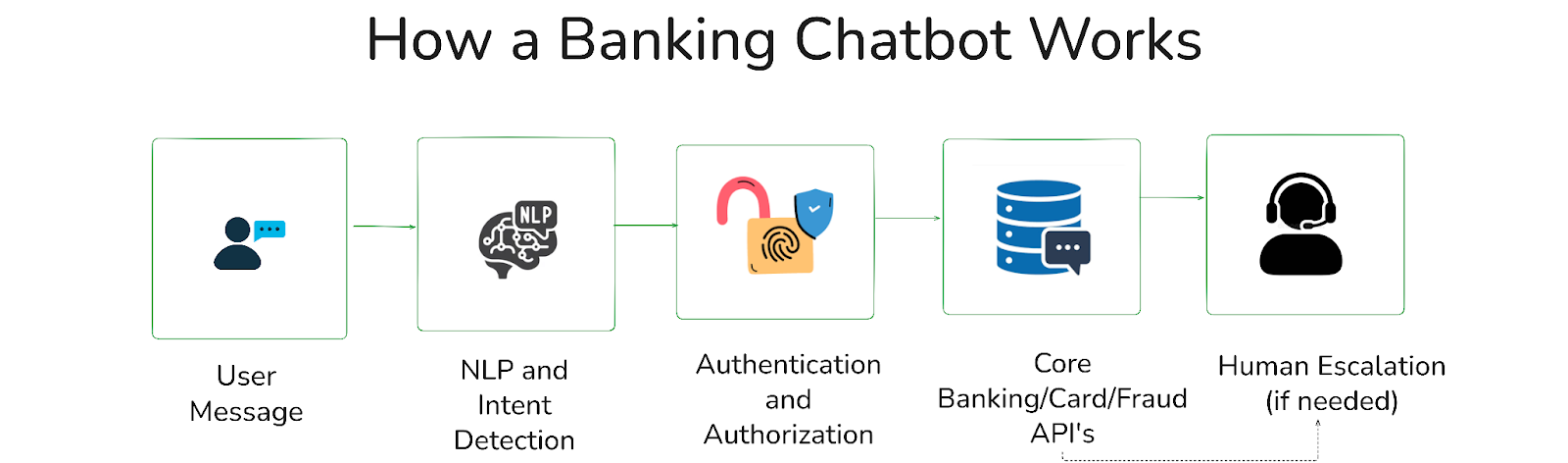
A typical banking chatbot processes customer input through several layers. Natural language processing (NLP) interprets the user’s message, extracting intent (what they want to do) and entities (specific account numbers, dates, or amounts). Intent detection routes the conversation to the appropriate logic, whether that’s retrieving account data, initiating a transaction, or escalating to a human agent. Dialogue management maintains conversation context across multiple exchanges, while integrations with core banking systems pull real-time data and execute authorized actions.
There are three primary types of chatbots used in banking today, each with different levels of intelligence and capability.
A banking chatbot is an automated conversational interface that enables customers to interact with banking services using natural language. It combines language understanding with secure system integrations to provide real-time assistance across common banking tasks.
It works through the following steps:
Understanding these architectural differences matters because each approach introduces distinct capabilities and limitations. The choice between rule-based predictability and GenAI flexibility directly influences the types of customer problems a chatbot can solve and the risks it introduces.
Building on the architectures discussed earlier, banks are increasingly deploying chatbots to handle everyday customer service interactions. Research published in Computers in Human Behavior demonstrates that chatbots are effective tools for automating banking and financial services, with 24/7 availability and speed emerging as key drivers of customer satisfaction. This supports broader industry findings that customers value instant responses to routine queries, regardless of time zone or demand peaks.
Banks currently use chatbots across a range of standardized service functions, including:
More advanced implementations support credit limit requests, fraud alert verification, spending analysis, and guided troubleshooting for digital banking features.
These use cases share a common pattern: high-volume interactions that benefit from immediate resolution. A customer checking their balance late at night receives an instant response, while someone detecting suspicious activity can block a card immediately, reducing potential losses. Measuring which of these flows resolves issues efficiently often relies on run tracking and performance visualization across deployed chatbot systems.
The operational impact is substantial. Automating routine interactions reduces call-center load and allows support teams to focus on more complex customer needs. Faster responses and round-the-clock availability improve the overall service experience, which is closely linked to higher customer satisfaction. Together, these benefits reinforce the strategic value of chatbots in modern banking operations.
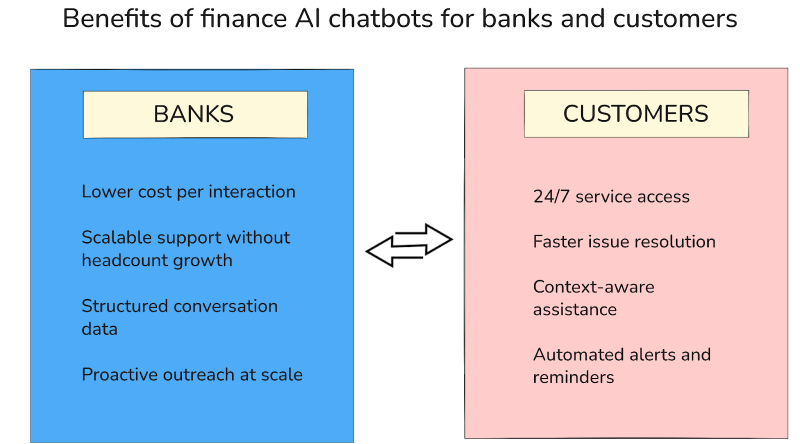
The value of finance AI chatbots becomes clearer when examining their impact on both banks and customers. While the benefits differ by perspective, improvements in operational efficiency and customer experience often reinforce one another.
For banks, cost efficiency is the most immediate advantage of deploying chatbots. Automating routine inquiries costs far less than handling them through live agents, especially at scale. This enables banks to support more customers without expanding service teams at the same rate. Chatbots also capture structured data from customer conversations, helping identify recurring issues and guide service improvements. Proactive engagement is possible at scale.
Key benefits of chatbots for banks include:
For customers, chatbots improve access and responsiveness. Banking services are available at any time without phone queues or branch visits. Routine questions receive instant answers, while complex issues are acknowledged quickly with clear next steps. AI chatbots in finance also provide limited contextual assistance.
Key benefits for customers include:
Research shows that chatbot features, such as fast and consistent responses and around-the-clock availability, are strongly linked to higher customer satisfaction in service settings. When chatbots handle routine tasks quickly and reliably, customers tend to trust them for simple interactions while relying on human agents for more complex cases.
Scalability further strengthens these benefits. A well-designed chatbot can serve many customers simultaneously, allowing banks to maintain service quality during peak demand periods.
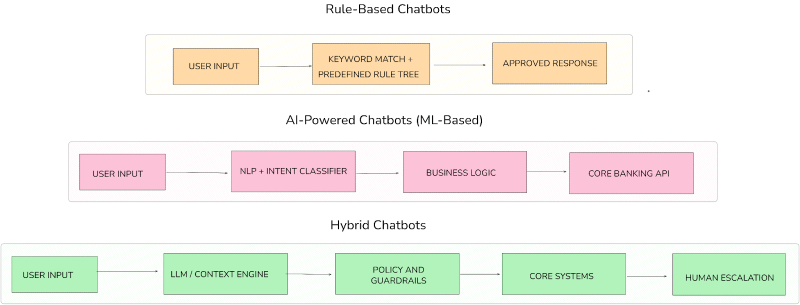
Banking chatbots generally fall into three architectural categories, each suited to different service scenarios and risk profiles.
Rule-based banking chatbots rely on explicitly defined decision trees, menus, and keyword matching. Every possible user path is preconfigured, and responses are deterministic.
These systems work best for low-complexity, high-confidence tasks, where correctness and auditability matter more than conversational flexibility. Typical use cases include:
Because behavior is fully deterministic, rule-based chatbot systems are easier to test and audit. From an MLOps perspective, they require minimal experimentation but still benefit from structured logging and outcome tracking to measure deflection rates and escalation frequency. In practice, teams often track these flows alongside ML-based systems to compare operational impact using experiment dashboards and usage analytics.
Hybrid chatbot architectures combine rule-based control for regulated or high-risk actions with ML or GenAI components for understanding, routing, and explanation. This is the most common architecture in production banking systems.
In a hybrid setup:
Hybrid chatbots in banking are best suited for higher-complexity, multi-step interactions, including:
Example:
A customer says, “I don’t recognize a $7,500 charge from last night. Can you block my card?”
The system understands the intent and explains the situation in plain language, while rule-based logic authenticates the user, locks the card, and initiates a dispute in the core banking system.
Evaluating these systems requires testing across increasing levels of task complexity rather than relying on a single accuracy metric.
Across these categories, architectural choice should align with task complexity and risk tolerance:
Comparing these approaches objectively requires consistent evaluation across task types to understand where each architecture performs well and where human intervention remains necessary. The experimental framework discussed in Computers in Human Behavior provides a useful reference for evaluating financial chatbot performance across increasing levels of task complexity, rather than relying on a single accuracy metric.
As mentioned above, rule-based banking chatbots use deterministic logic to route users through predefined conversational flows, responding based on matched conditions rather than generating new language.
Example: If a customer types “balance,” the chatbot matches the keyword to a predefined flow: authenticate the user, query the account database, and return the current balance. Selecting a menu option like “Report lost card” triggers a fixed sequence of prompts that leads to card blocking.
Key advantages of rule-based chatbots include:
Despite these strengths, rule-based systems have clear limitations.
Key limitations include:
These limitations align directly with CFPB (Consumer Financial Protection Bureau) concerns about customer service quality. Even when responses are accurate and compliant, customers can become frustrated if rigid flows force them through long menus or if escalation to a human agent is not easy. In such cases, the predictability that makes rule-based chatbots safe from a regulatory standpoint can negatively affect customer experience.
AI-powered chatbots apply trained models to interpret user messages, identifying intent and relevant details from natural language. By learning from prior interactions, they recognize varied expressions of the same request and manage overlapping intents without relying on rigid keyword rules.
Finance AI chatbots extend this approach using generative AI and large language models. These systems support more natural, context-aware conversations by maintaining dialogue state and learning from prior interactions, both across the user population and within individual sessions. Responses are generated dynamically rather than selected from fixed scripts, which reduces conversational friction.
Example: A customer asking “Why was I charged this fee?” can receive a contextual explanation that summarizes the relevant fee rule, references the specific transaction, and explains next steps, rather than being routed through multiple static FAQ pages.
Additional capabilities commonly enabled by Gen AI include:
These capabilities position GenAI systems as a strong candidate for handling higher-complexity customer service interactions that previously required human agents. Evaluating such systems typically involves tracking prompt variants, model versions, and response quality across scenarios, an approach aligned with structured LLM evaluation workflows.
At the same time, these systems introduce elevated risk. Hallucinations can lead to confidently stated but incorrect information about fees, timelines, or customer rights. Data leakage concerns increase when models process sensitive financial context. Regulatory exposure also rises, as dynamically generated responses may not follow the deterministic, auditable paths expected in banking environments.
As a result, while AI-powered and GenAI represent the likely future of finance chatbots, their deployment requires careful evaluation, monitoring, and governance to balance conversational flexibility with accuracy, compliance, and customer trust.
Leading financial institutions have moved beyond basic chatbot deployments and now operate systems with deeper capabilities and tighter system integration. While implementations differ, advanced banking chatbots tend to share several common characteristics.
Cross-product natural language queries are a key differentiator. These chatbots understand questions spanning multiple accounts and products, rather than requiring users to query each one separately.
Example: A customer asks, “What is my total monthly obligation to the bank, including my mortgage payment, credit card minimums, and personal loan EMI?”
The chatbot aggregates data across checking, credit cards, loans, and mortgage accounts to provide a single consolidated view. This enables customers to understand their full financial position with the bank, supporting budgeting and cash-flow planning rather than forcing them to review each product separately.
Personal financial management insights represent another area of maturity. Advanced chatbots analyze historical transaction data to surface spending summaries, budgeting guidance, and savings suggestions. They can also notify users when spending in a category exceeds typical patterns, shifting the chatbot from a reactive tool to a proactive assistant.
Integrated card controls and dispute flows reduce friction during security-related interactions. Customers can report suspicious transactions, lock or unlock cards, adjust spending limits, and initiate disputes directly through conversation. This avoids switching between apps or calling separate fraud support lines during time-sensitive situations.
Cross-channel availability extends the chatbot beyond a single interface. The same conversational experience appears across mobile apps, web platforms, messaging services, and sometimes voice assistants. Conversation context often persists across channels, allowing users to start an interaction on one device and continue it on another without repeating details.
Real-world case study: Bank of America’s virtual financial assistant Erica demonstrates many of these capabilities in action. Since its launch in 2018, Erica has been deeply integrated into the mobile banking experience, assisting millions of users with tasks ranging from spending insights to balance checks and personalized alerts. Bank of America reports that Erica has handled billions of interactions and delivers proactive, tailored information that helps customers manage their finances more efficiently.
However, these capabilities only improve satisfaction when execution is reliable. A chatbot that hallucinates incorrect information, fails to escalate to a human, or overwhelms users with excessive notifications will reduce trust. In practice, banks monitor these outcomes by evaluating resolution rates, escalation frequency, and user feedback across chatbot versions, often using structured experiment tracking and analysis workflows, such as those described in Weights & Biases’ documentation.
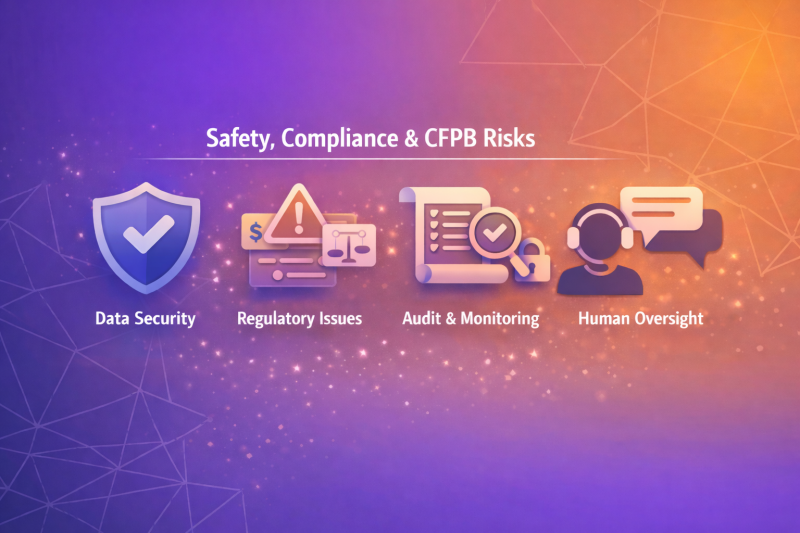
The CFPB has consistently emphasized that while financial chatbots can improve efficiency, they also introduce risks that can directly harm consumers if not properly governed. These risks apply across all chatbot architectures, including rule-based systems, ML-powered chatbots, and GenAI assistants.
One major concern is non-compliance with federal consumer protection laws. Chatbots may provide incorrect or incomplete information about customer rights, fees, dispute timelines, or eligibility requirements. Errors in these areas can lead customers to miss legally mandated deadlines or misunderstand their obligations. Privacy and data handling issues are also critical, particularly when chatbots process sensitive financial information without clear safeguards or transparency.
Key compliance-related risks include:
The CFPB has also raised concerns about diminished customer service quality when chatbots act as barriers rather than entry points to support. Customers can become frustrated when chatbots provide unclear answers, repeat generic responses, or make it difficult to reach a human agent. This frustration can erode trust, especially in situations involving financial stress, fraud, or urgent account issues.
Customer experience risks include:
Another critical risk is direct consumer harm. When customers act on inaccurate chatbot guidance, the consequences can be serious. For example, a chatbot that incorrectly explains a dispute deadline or repayment requirement may cause a customer to lose protections they would otherwise be entitled to. Even small errors can compound when customers rely on automated advice for financial decisions.
These risks are not limited to advanced GenAI systems. Rule-based chatbots can cause harm through overly rigid logic, while ML-based and GenAI chatbots introduce additional risks, including model errors, hallucinations, and inconsistent responses. As a result, the CFPB stresses the importance of strong governance regardless of chatbot type.
Across all architectures, safe deployment requires:
In banking environments, chatbots should be treated as regulated service channels rather than simple automation tools. Strong oversight and human-in-the-loop controls are essential to ensure that efficiency gains do not come at the expense of compliance, customer trust, or consumer protection.
The impact on satisfaction from successfully deployed chatbots comes from a combination of functional improvements and emotional factors that shape how customers perceive their relationship with the bank.
Example: A customer who previously asked about saving goals may receive proactive suggestions when their account shows an unusual surplus, while a frequent traveler may receive alerts about foreign transactions. Such contextual awareness increases perceived value without requiring additional effort from the customer.
Key proactive benefits include:
Example: A message such as “You spent 30% more on dining out this month compared to your three-month average” provides actionable insight that can influence budgeting decisions. Pattern-based fraud warnings further add protective value by prompting a quick customer review.
At the same time, these benefits depend heavily on reliability and guardrails. A chatbot that provides incorrect information, fails to recognize when human escalation is needed, or overwhelms users with excessive notifications can reduce satisfaction rather than improve it. Research consistently shows that execution quality matters more than feature breadth. When chatbots are accurate, respectful of user preferences, and easy to escalate, satisfaction increases. When they frustrate or mislead, satisfaction can fall below that of traditional service channels.
For banks, the takeaway is clear. Enhancing customer satisfaction requires not only capable AI technology but also thoughtful implementation that prioritizes trust, clarity, and user needs over automation for its own sake.
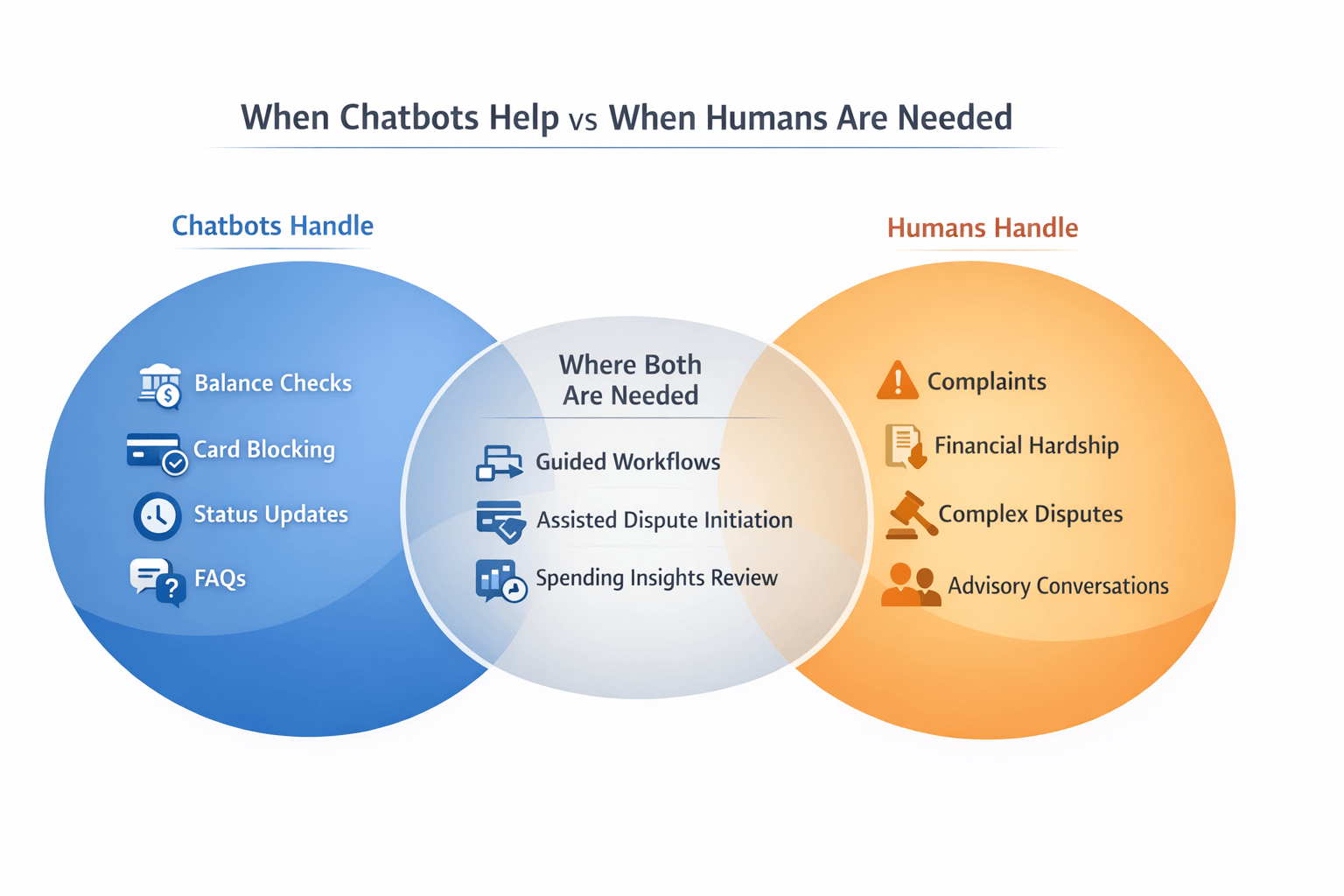
The dominant view is cautiously optimistic. Banking chatbots are seen as valuable and increasingly necessary, but not yet capable of handling the full range of customer service complexity.
Professionals acknowledge that chatbots perform well in routine and semi-structured interactions, offering speed, availability, and consistency. At the same time, limitations remain in areas involving ambiguity, emotional context, or complex decision-making. As a result, chatbots are viewed as systems with strong learning potential rather than complete replacements for human service.
Common themes in industry sentiment include:
Rather than replacing human advisors, chatbots are positioned as a core component of digital engagement strategies. They handle high-volume, repetitive interactions, while human agents focus on judgment, empathy, and complex problem resolution.
Professionals increasingly describe chatbots as part of a broader AI-driven shift in corporate customer service. Their long-term impact depends less on technical capability alone and more on effective integration with human workflows and governance structures.
Deploying chatbots in banking is not only a technical decision but a strategic one. Insights from regulatory guidance, industry research, and real-world deployments point to the same conclusion: chatbot success depends on how well automation aligns with customer trust, service quality, and compliance obligations, not just operational efficiency.
A common pitfall is treating chatbots primarily as a cost-reduction tool. Leading institutions instead align chatbot objectives with customer-centric metrics, including resolution quality, satisfaction, and perceived fairness. Chatbots that resolve issues accurately and transparently tend to build trust, while those optimized only for deflection or speed risk increasing complaints and regulatory scrutiny.
Strong governance is central to sustainable deployment. Chatbots must be tested for legal and policy accuracy, particularly in areas involving fees, disputes, timelines, and customer rights. Ongoing monitoring of customer complaints and failure cases is necessary to identify where automation causes confusion or harm.
Key governance considerations include:
Ultimately, banking chatbots should be treated as regulated service channels rather than experimental features. Institutions that combine capable technology with careful governance and human oversight are better positioned to improve customer experience while meeting regulatory expectations.
Chatbots have become an essential part of modern banking. They enable scale, speed, and continuous availability, handling high volumes of routine interactions efficiently. At the same time, they are not a replacement for human advisors. Their real value lies in supporting human services by reducing friction in everyday tasks while leaving complex, sensitive decisions to people.
Financial AI chatbots and GenAI assistants bring a clear dual impact. They can significantly improve customer satisfaction through personalization, proactive support, and conversational access to financial information. However, they also introduce meaningful risks related to accuracy, compliance, and consumer harm if not carefully governed. The benefits only materialize when these systems are reliable, transparent, and designed with clear escalation paths.
Looking ahead, the future of banking chatbots will depend on responsible use of intelligence rather than unchecked automation. Continuous evaluation, safeguards, and thoughtful integration with human workflows will determine whether chatbots strengthen customer trust or undermine it. For industry professionals and informed customers alike, the key is to evaluate chatbots not just by convenience, but by how well they balance efficiency with accountability.